Office Cleaning vs In House Janitors: Which Fits?
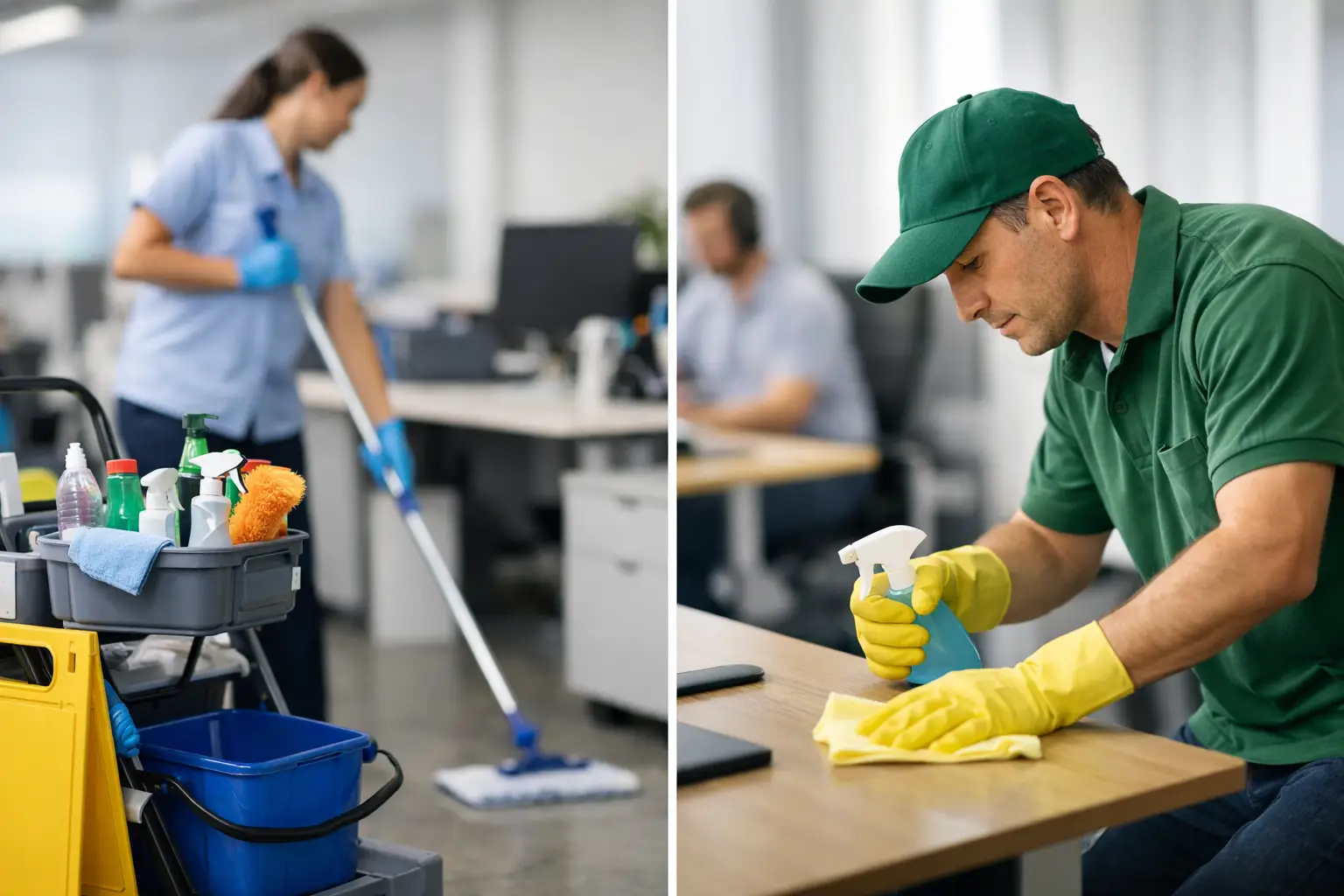
A missed restroom check, an overflowing trash can before a client meeting, or fingerprints left on a glass entry door can quickly become an office management problem. When comparing office cleaning vs in house janitors, the real question is not simply who can clean the building. It is which model gives your facility the right level of coverage, control, consistency, and accountability without creating a new management burden.
For offices, medical practices, multi-tenant properties, gyms, and other commercial spaces, both options can work. The better fit depends on how your facility operates, when cleaning must happen, how quickly needs change, and who will be responsible when a task is missed.
Office Cleaning vs In House Janitors: The Core Difference
An in-house janitorial model means your organization hires, trains, schedules, supervises, and manages cleaning staff directly. The staff members are employees of your business or property, and your team handles payroll, benefits, coverage, supplies, equipment, and performance management.
A commercial cleaning company provides a contracted team under an agreed scope of work. The provider is responsible for staffing the account, coordinating the work, training its employees, conducting inspections, and communicating with the client about issues or changes.
Neither arrangement is automatically better. A large facility with continuous daytime needs may benefit from a dedicated on-site employee. A smaller office that needs detailed after-hours service may find that a contracted cleaning plan is easier to manage and more predictable. The key is to compare the full operational picture, not just the hourly wage or monthly proposal.
Cost Is More Than an Hourly Rate
In-house staffing can appear less expensive when the comparison starts and ends with labor. But a janitorial employee's wage is only one part of the expense. Employers also need to account for payroll taxes, benefits, workers' compensation, paid time off, hiring time, training, uniforms, supplies, equipment, storage, and replacement coverage.
There is also a less visible cost: supervision. Someone in your organization must assign priorities, confirm work is complete, respond to callouts, address performance concerns, and order supplies. For an office manager or practice administrator already responsible for vendors, staff, visitors, and daily operations, that oversight can consume more time than expected.
With outsourced office cleaning, the quoted price generally reflects a defined service plan and the provider's staffing structure. That does not mean every proposal covers the same work. A low monthly figure can omit periodic floor care, detailed high-touch cleaning, supply management, daytime porter coverage, or inspection activity. The most useful comparison is between complete scopes of work, not between two numbers on a spreadsheet.
Questions that reveal the real cost
Before choosing either model, clarify who pays for absentee coverage, cleaning equipment repairs, onboarding, floor maintenance, consumables, and emergency service. Also ask how work outside the routine schedule is approved and billed. These details determine whether a cleaning program remains predictable when the building has an unexpected need.
Coverage and Scheduling Often Decide the Outcome
In-house janitors can be a strong option when a facility needs frequent daytime attention. A busy medical office, large corporate campus, school-like setting, or high-traffic property may need restrooms checked throughout the day, spills handled immediately, meeting rooms reset, and common areas monitored while the building is occupied.
That level of access is valuable, but it requires a staffing plan that covers breaks, vacations, sick days, and turnover. One dedicated employee may know the facility well, yet a single absence can leave the entire operation uncovered unless management has a backup plan.
A commercial cleaning company is often well suited to scheduled evening cleaning, recurring service at multiple locations, or facilities where the workload changes by day. A capable provider can assign a team based on the building's size, traffic, surfaces, business hours, and service requirements. If one cleaner is unavailable, the provider should have a documented plan to keep the visit from being missed.
For many facilities, the answer is not entirely one or the other. A property may keep a daytime porter on staff for immediate needs while using a commercial cleaning team for nightly detail work, carpet cleaning, hard floor care, and periodic projects. This hybrid model can make sense when the day-to-day demands are constant but specialized work does not justify full-time internal staffing.
Control Is Useful Only When It Is Supported by Oversight
Some facility leaders prefer in-house staff because they want direct control. They can change priorities quickly, speak to the employee in person, and adjust assignments as events or occupancy change. That can be an advantage in a fast-moving environment.
Direct control, however, also means direct responsibility. If expectations are not written down, cleaning becomes dependent on memory, informal conversations, and individual habits. Over time, those informal systems can lead to uneven results. One person may know that a conference room needs attention before Monday mornings, while a replacement may not.
A contracted provider should bring structure to the relationship through a site-specific scope of work. That document should identify areas to be cleaned, frequencies, special instructions, access procedures, service times, and tasks that require approval. It should also make clear what happens when an issue is reported.
The CEECEE Standard is built around this kind of clarity: defined expectations, consistent follow-through, communication, and documented quality checks. The objective is not to make a client manage a vendor more closely. It is to make the standard visible enough that missed details can be identified and corrected promptly.
Quality Depends on Systems, Not Good Intentions
An experienced in-house janitor can deliver excellent results, especially when the employee has proper training, adequate time, the right tools, and clear supervision. The risk comes when quality relies entirely on one person's knowledge and effort. When staffing changes, the process may have to be rebuilt.
A commercial cleaning partner should reduce that dependency by using repeatable processes. Supervisory checks, checklists, communication logs, and periodic inspections help confirm that the work matches the agreed plan. They also create a record of recurring concerns, such as streaked entry glass, neglected baseboards, inconsistent restroom restocking, or floors that need additional care.
For a medical or dental office, this structure is especially useful because room functions, patient schedules, and high-touch areas often require precise instructions. For an auto dealership, appearance priorities may center on showroom glass, restrooms, customer lounges, and service-area floors. A generic approach is rarely enough. The cleaning plan should reflect how the facility is actually used.
Communication and Accountability Are the Practical Test
Most cleaning frustrations do not begin with an impossible request. They begin when a concern has no clear owner. An office manager notices that trash was not removed from a training room, reports it, and then has to follow up repeatedly. That is where the cleaning model breaks down.
With internal staff, accountability rests with your management team. That may be appropriate if you have a facilities department and established supervisory processes. In a smaller organization, the responsibility often lands on someone whose main job is not janitorial management.
With an outsourced provider, accountability should rest with a named point of contact and a clear escalation process. Ask how concerns are reported, who responds, how quickly corrections are addressed, and whether recurring issues are reviewed. The answer should be specific. “Call us if you need anything” is not a management system.
How to Choose the Right Model for Your Facility
Start by looking at your facility's actual cleaning demands over a normal month. Consider occupancy, business hours, visitor traffic, restroom volume, special surfaces, security requirements, and the need for daytime response. Then assess your internal capacity to recruit, train, supervise, and cover cleaning personnel.
In-house janitors may fit best when you need an on-site person throughout the day and have the management structure to support that employee. Outsourced office cleaning may fit best when you want a defined recurring plan, coverage beyond one employee, specialized capabilities, and a vendor accountable for staffing and inspections.
Whichever route you choose, ask for the same basics: a written scope, clear service frequencies, a process for missed work, defined points of contact, and a plan for coverage. Those fundamentals protect first impressions and make cleaning easier to manage.
If your Newark-area facility is weighing these options, a walkthrough can turn general assumptions into a practical plan. Seeing the traffic patterns, workspaces, restrooms, floors, and operating hours in person makes it easier to determine the level of staffing and oversight your building truly needs.
Call (917) 837-6499 or email info@ceeceecleaning.com